Home Speech Therapy Exercises for the Holidays

The holiday season brings families together, creating natural opportunities to support loved ones working through speech and communication challenges.
Whether someone is recovering from a stroke, managing Parkinson's disease, or navigating dementia-related communication changes, the warmth and togetherness of the holidays can provide an ideal setting for therapeutic activities that don't feel clinical or forced.
These exercises are designed to blend seamlessly into holiday gatherings, transforming everyday moments into opportunities for gentle practice. The key is keeping things lighthearted and pressure-free, because when therapy feels like family fun rather than homework, everyone benefits!
Table of Contents
Jump to a section below, or scroll to read in full.
- Important Considerations Before You Begin
- Understanding Common Speech and Communication Challenges
- Activities: Breathing and Vocal Strengthening
- Activities: Articulation and Speech Clarity
- Activities: Word-Finding and Naming
- Activities: Memory and Conversational Practice
- Interactive Games and Activities
- Tips for Different Conditions
- Tracking Progress and Adjustments
- When to Seek Professional Help
Important Considerations Before You Begin
Before incorporating any speech therapy exercises at home, consult with a licensed speech-language pathologist (SLP) who can assess your loved one's specific needs and provide personalized recommendations. The suggestions here are general guidelines drawn from evidence-based practices, not a replacement for professional evaluation and treatment.
Keep these principles in mind for successful home practice:
Session Length: Aim for brief sessions of 10 to 15 minutes to prevent fatigue and maintain engagement. Multiple short sessions throughout the day are often more effective than one long session.
Positive Environment: Create a supportive atmosphere where everyone offers encouragement and celebrates small victories. Avoid correction or criticism, which can increase anxiety and hinder progress.
Individual Pacing: Let your loved one set the pace. Some days will be better than others, and that's completely normal. Watch for signs of tiredness or frustration and be ready to take breaks.
Make It Social: The best holiday therapy doesn't feel like therapy at all. Incorporate these exercises into natural family moments like decorating, cooking together, or sharing stories around the table.
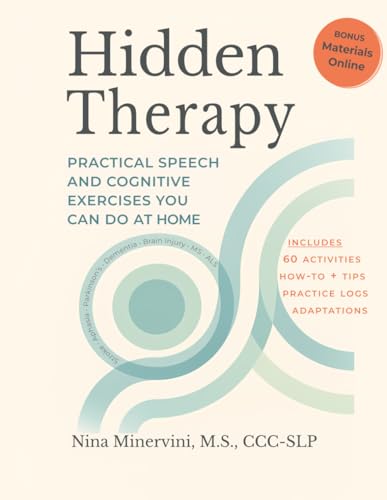
Hidden Therapy: Practical Speech and Cognitive Exercises You Can Do At Home
Make the most of every day with family and friends with communicative activities designed to build connections while helping adults overcome the difficulties of Parkinson's, stroke recovery, dementia, and other conditions. This comprehensive activity book includes 60 therapeutic exercises specifically designed for home practice, with detailed adaptations built into each activity.
- 60 Therapeutic Activities
- 11 Different Themes
- Support for Caregivers
- Bonus Materials Online

Understanding Common Speech and Communication Challenges
To better support your loved one, it helps to understand what they might be experiencing:
Aphasia (often from stroke) affects language processing, such as finding the right words, understanding others, reading, or writing. The person's intelligence remains intact, but accessing and expressing language becomes difficult.
Dysarthria (from stroke or Parkinson's) involves weak or uncoordinated speech muscles, leading to slurred, quiet, or effortful speech. The person knows what they want to say but has trouble producing clear sounds.
Parkinson's-related speech changes often include reduced volume, monotone quality, rushed or hesitant speech, and decreased facial expression.
Dementia-related communication difficulties may involve word-finding problems, confusion about topics, repetition, difficulty following conversations, and challenges with abstract concepts.

Activities: Breathing and Vocal Strengthening
Strong breath support is the foundation of clear, audible speech. These exercises are particularly valuable for people with Parkinson's disease or recovering from stroke.
Deep Breathing with Sustained Sounds
Sit comfortably in a chair with feet flat on the floor. Take a slow, deep breath through your nose, then produce a steady "Ah" sound as loudly as possible for 5 to 10 seconds. The goal is consistent volume and duration, not straining. Repeat 5 to 10 times, resting between repetitions.
Holiday Adaptation:
Turn this into a group activity before singing holiday carols together. Everyone participates in the warm-up, making it a shared experience rather than singling out the person who needs practice. You might also try sustaining the first note of familiar songs like "Silent Night."
Why it works:
This exercise strengthens the muscles used for breathing and voicing, helping combat the reduced volume common in hypokinetic dysarthria associated with Parkinson's disease and weakness following stroke.
Counting with Increasing Volume
Start by counting from 1 to 10 in a normal voice, then repeat at a louder volume, then louder still. Think of it as speaking to someone across the room, then across the yard. Do this 3 times daily.
Holiday Adaptation:
Count ornaments on the tree, cookies on a plate, or days until New Year's while practicing volume control.
Pitch Glides
Say "Hello" while sliding your voice from low pitch to high pitch, like going up a slide. Then reverse from high to low. Repeat 10 times. This increases vocal flexibility and range.
Holiday Adaptation:
Practice saying holiday greetings like "Merry Christmas" or "Happy Holidays" with exaggerated pitch changes, making it playful and festive.

Activities: Articulation and Speech Clarity
Clear articulation requires coordinated movement of the lips, tongue, jaw, and soft palate. These exercises target the muscle strength and precision needed for understandable speech.
Tongue Twisters and Exaggerated Speech
Choose simple phrases and practice them slowly at first, exaggerating every mouth movement. Use a mirror so the person can watch their own articulation.
Start with 3 repetitions at a slow pace, then gradually increase speed if comfortable. Classics like "Peter Piper picked a peck of pickled peppers" or "Red leather, yellow leather" work well.
Holiday Adaptation:
Create holiday-themed twisters that the whole family can attempt together: "Santa's sleigh slides swiftly through snow," "Frosty's frozen friends frolic freely," or "Gingerbread garlands grace Grandma's garden gate."
Make it a friendly competition where everyone trips over words together, removing any self-consciousness.
Why it works:
Exaggerated movements strengthen the muscles and increase awareness of articulatory placement, helping reduce slurring and imprecision in dysarthria.
Oral Motor Exercises
These facial exercises build strength and coordination:
Smile Stretch: Smile as widely as possible, hold for 2 to 3 seconds, relax. Repeat 10 times.
Lip Pucker: Pucker lips tightly as if for a kiss, hold for 3 seconds, relax. Repeat 10 times.
Tongue Laterals: Stick out your tongue and move it slowly from left corner to right corner of your mouth. Repeat 10 times.
Tongue Elevation: Touch the tip of your tongue to the bumpy ridge behind your upper teeth, hold for 3 seconds. Repeat 10 times.
Cheek Puffs: Puff air into your cheeks, hold for 5 seconds, release. Repeat 5 times per side.
Holiday Adaptation:
Practice these while looking at holiday decorations together, or do them as a group "silly faces" activity that children will especially enjoy joining.
Overarticulation Practice
Read holiday cards, recipes, or gift lists aloud while deliberately over-pronouncing every word. Focus on crisp consonants and open vowels. Practice for 5 minutes at a time.
Holiday Adaptation:
Read the holiday menu, describe wrapped presents by color and size, or narrate what you're doing while preparing holiday meals together.

Activities: Word-Finding and Naming
For people with aphasia or dementia, retrieving specific words can be frustrating. These exercises provide practice in a low-pressure environment.
Object Naming and Description
Walk through your home or focus on holiday decorations, systematically naming every item you see.
Start with simple labels ("tree," "star," "candle"), then expand to descriptions ("sparkling silver star," "cinnamon-scented candle"). If the person gets stuck, family members can provide cues like the first sound, the category, or a gesture representing the object. Aim to name 10 to 20 items per session.
Holiday Adaptation:
Make it a scavenger hunt where everyone takes turns finding and naming ornaments, ingredients in the kitchen, or items in wrapped packages by feeling them. Describing holiday foods engages multiple senses and provides natural conversation starters.
Why it works:
Repetitive naming practice strengthens neural pathways for word retrieval, and contextual cues help with recall in aphasia and dementia.
Category Listing Games
Set a timer for one minute and challenge everyone to name as many items as possible from a category.
Try "holiday foods," "winter clothing," "family members' names," "gifts you've received," or "things that are red." Keep score to add friendly competition.
Holiday Adaptation:
Theme categories around your family's traditions—dishes at your holiday meal, places you've traveled together, or names of people you're grateful for this year.
Sentence Completion
Start familiar holiday phrases and have your loved one complete them: "Jingle bells, jingle bells, jingle all the ___," "Deck the halls with boughs of ___," or "We wish you a merry Christmas and a happy new ___."
Holiday Adaptation:
Use family traditions as prompts too: "Every year we bake ___," "Grandma always makes her famous ___," or "On Christmas morning we ___."

Activities: Memory and Conversational Practice
These activities support both memory and the flow of natural conversation, particularly valuable for people with dementia or recovering from stroke.
Photo Album Storytelling
Bring out family photo albums, especially those featuring past holidays. Look at each photo together and encourage your loved one to describe what they see, who's present, what happened, and how they felt.
Family members should ask open-ended questions like "What happened next?" "How old were you here?" "What do you remember about that day?" rather than yes/no questions.
Holiday Adaptation:
The holidays naturally invite reminiscing. Create a tradition of looking through old holiday photos before or after meals, allowing everyone to share memories. This validates your loved one's experiences and keeps them connected to family history.
Why it works:
Visual cues help trigger memories, and storytelling practice supports narrative skills and conversational turn-taking. The emotional connection to photos often facilitates language in ways that abstract exercises cannot.
Sing-Along Sessions
Music engages different brain pathways than speech, which is why people with severe aphasia can sometimes sing words they cannot speak.
Play familiar holiday songs and sing together, focusing on clear pronunciation rather than perfect pitch.
If words are forgotten, humming or using gestures is perfectly fine, since the act of participating matters most.
Holiday Adaptation:
Create a holiday playlist of your loved one's favorite songs from their youth. Carols, hymns, and nostalgic tunes from their past often work best. Encourage clapping, swaying, or using simple rhythm instruments to make it multisensory.
Structured Conversation Prompts
During holiday meals, go around the table with prompts that everyone answers: "My favorite holiday memory is...", "I'm grateful for...", "The funniest thing that happened this year was...", or "My wish for next year is..." This creates natural conversation practice with built-in support.
Holiday Adaptation:
Make this a daily ritual during extended holiday visits. The structure helps people with language difficulties prepare and participate more fully.
Recipe Following and Cooking Narration
Work together in the kitchen, with your loved one reading the recipe aloud step by step or narrating what they're doing as they help prepare food. This combines reading practice, following sequences, and functional communication.
Holiday Adaptation:
Choose simple recipes that become yearly traditions. The familiarity will make the task easier over time, and you're creating delicious memories together.

Interactive Games and Activities
Games provide excellent speech therapy disguised as entertainment, engaging the whole family while targeting specific skills.
Adapted Board and Card Games
Classic games can be modified to emphasize communication:
Charades with Descriptions: Instead of just acting, the person must also describe what they're pantomiming using words.
Pictionary with Narration: As you draw, describe what you're drawing and why.
Scattergories: This game naturally requires generating words in categories under time pressure, perfect for word-finding practice.
Apples to Apples or Taboo: These games require explanation and description, excellent for expressive language.
Trivia Games: Use holiday-themed trivia where everyone can participate at their own level.
Holiday Adaptation:
For people with Parkinson's, encourage projecting their voice loudly during their turn. Make "loud talking" part of the game rules for everyone. For those with aphasia, allow extra time and permit gestures or drawing as supplements.
Reading Aloud Together
Take turns reading holiday stories, cards from friends, or passages from favorite books. The reader can pause to discuss the content, explain unfamiliar words, or predict what happens next.
Choose materials at an appropriate reading level. Children's holiday books work beautifully and aren't condescending when shared with grandchildren.
Holiday Adaptation:
Make this a nightly tradition during holiday visits. Children love hearing stories read by grandparents, creating meaningful intergenerational bonding.
Show and Tell
Each family member brings an object to the table and talks about it for 1-2 minutes. It could be a favorite ornament, a meaningful gift, a photo, or anything with a story. Others can ask questions to keep the conversation going.
Holiday Adaptation:
Focus on holiday-related items or gifts received that day. The familiar, personal context makes speaking easier.
Virtual Connection Activities
For family members who can't visit in person, video calls provide communication practice too. Encourage your loved one to show and describe decorations, read holiday cards on camera, or participate in virtual games like online charades or trivia.

Tips for Different Conditions
For Stroke Recovery with Aphasia
Use multi-sensory cues: show pictures, write words, use gestures alongside speech
Be patient! Give at least 30 seconds for responses before offering help
Accept all forms of communication: gestures, drawing, partial words
Don't pretend to understand if you don't; politely ask for clarification
Avoid infantilizing language or speaking loudly (hearing is typically fine)
For Parkinson's Disease
Emphasize LOUD and BIG in all exercises, as volume is often the main challenge
Practice in front of mirrors to increase awareness of reduced facial expression
Encourage deliberate, exaggerated movements
Schedule practice when medication effects are optimal
Be aware that fatigue significantly impacts speech
For Dementia
Keep instructions simple and break tasks into small steps
Use familiar, meaningful activities rooted in long-term memories
Maintain routine and structure for comfort and success
Be flexible and follow the person's lead on topics that engage them
Focus on connection over correction

Tracking Progress and Adjustments
Keep a simple log of activities and observations. Note things like:
Which exercises were enjoyed most
Improvements in clarity, volume, or word-finding
Energy levels and optimal times of day
Topics or activities that sparked engagement
Any concerns or changes that should be reported to the SLP
Celebrate small victories: holding a sound longer, speaking more loudly, finding a word independently, or participating more actively in conversation. Progress isn't always linear, and some days will be harder than others. That's normal and expected.
When to Seek Professional Help
While these home exercises complement professional therapy, certain situations require immediate attention from healthcare providers:
New difficulty understanding others
Confusion or disorientation beyond baseline
Signs of depression or withdrawal from activities
Choking or coughing frequently during meals
Complete loss of voice or inability to produce sound
Early Dementia Signs: Read the Two Part Series

The Gift of Connection
The most powerful aspect of holiday speech therapy with family and friends is the connection they facilitate.
When a grandmother successfully names all her grandchildren, when a grandfather leads the blessing at dinner in a strong voice, when a parent with aphasia laughs at a shared joke, these moments of successful communication are profound gifts.
Speech challenges can lead to isolation and withdrawal, but the holidays offer a natural antidote: belonging, tradition, and love. By weaving therapeutic activities into holiday celebrations you're affirming that your loved one remains a vital part of the family story.
These exercises strengthen more than muscles and neural pathways; they strengthen bonds. They communicate, without words, that someone's voice matters, that their stories are worth hearing, and that the effort to connect is always worthwhile.
Make this holiday season one of patience, creativity, and joyful practice. The memories you create together will be therapeutic in ways that transcend any single exercise.
Looking for personalized support beyond home practice?

Nina Minervini, M.S., CCC-SLP provides in-home speech therapy throughout Palm Beach County, meeting clients where they’re most comfortable. Whether your loved one is recovering from a stroke, managing Parkinson’s disease, or navigating dementia-related communication changes, Nina tailors therapy to real-life needs while focusing on clarity, confidence, and meaningful connection.
Online: Contact Nina today for a thorough evaluation and customized therapy plan.
Phone: (561) 797-2343
Email: ninaminervini11@gmail.com
If you’re in Palm Beach, Delray Beach, Boynton Beach, Lake Worth, or surrounding areas, Palm Beach Speech Therapy offers compassionate, one-on-one care in the comfort of your home. Reach out to schedule an evaluation or learn whether in-home speech therapy is the right next step for your family.
Always consult with your loved one's speech-language pathologist before beginning home exercises. These suggestions are educational in nature and do not constitute medical advice. If you have concerns about swallowing, breathing, or significant changes in communication abilities, seek immediate evaluation from qualified healthcare professionals.
