Every year on April 11, World Parkinson's Day brings global attention to one of the most complex neurological conditions affecting adults today.
In 2026, Parkinson's Europe has centered its awareness campaign on a message that resonates deeply for families across Palm Beach County: "bridge the care gap."
That phrase is more than a slogan. It reflects a real and persistent reality.
Many people living with Parkinson's are not getting the full scope of support they need, often because so much of the conversation about Parkinson's focuses on movement and so little of it focuses on communication and swallowing.

If someone you love has Parkinson's, you may already be navigating the challenges of tremor, stiffness, and slower movement. But there is another layer of Parkinson's that families often discover quietly, over time, without fully recognizing what they are seeing:
a voice that is getting softer
speech that is harder to follow
meals that are taking longer
coughing that seems to accompany every bite
These are not minor inconveniences.
They are neurological symptoms, and they respond to treatment with a licensed SLP with years of experience.
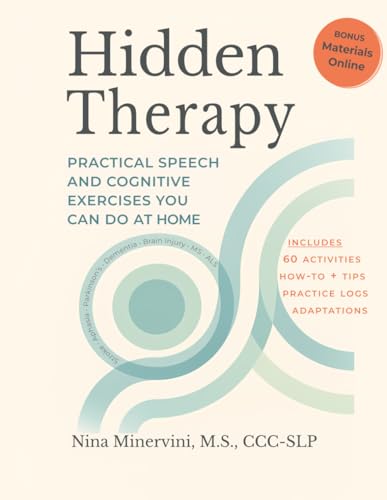
Hidden Therapy: Practical Speech and Cognitive Exercises You Can Do At Home
Your family and friends who have been diagnosed with Parkinson's can benefit from communicative activities with an SLP...and they can also benefit from activites with those closest to home! It's as easy as starting a conversation guided towards your loved one's needs.
- 60 Therapeutic Activities
- 11 Different Themes
- Support for Caregivers
- Bonus Materials Online
Parkinson's Affects Far More Than Movement
Most people associate Parkinson's with its most visible symptoms: tremor, rigidity, shuffling gait, and slowed movement. Less understood is that Parkinson's is also a disease of communication.
It affects the muscles involved in breathing, voicing, articulating speech, facial expression, and swallowing, often beginning subtly and progressing in ways that are easy to dismiss until the impact on daily life becomes undeniable.
The Parkinson's Foundation estimates that as many as 75 to 90 percent of people with Parkinson's will experience some degree of speech or voice changes over the course of the disease.

That is an extraordinary number, and it makes the consistent underreferral to speech-language pathology one of the most significant gaps in Parkinson's care.
The reason Parkinson's affects speech the way it does comes down to neurochemistry.
The disease progressively reduces dopamine production in the substantia nigra, a region of the brain critical to smooth, coordinated movement.
The muscles involved in speech, including the diaphragm, vocal cords, tongue, lips, and jaw, are movement muscles.
As Parkinson's progresses, it affects the amplitude of those movements, producing what clinicians call hypokinetic dysarthria: speech that is reduced in volume, clarity, and expressiveness. I've written a detailed overview of dysarthria and how it presents in Parkinson's in my post on understanding dysarthria.
The Specific Ways Parkinson's Changes Communication
Speech changes in Parkinson's are not random. They follow predictable patterns that clinicians are trained to identify and treat. Common changes include:
Hypophonia (soft voice)
This is one of the earliest and most widely reported symptoms. The voice becomes quieter, sometimes dramatically so, and the person with Parkinson's is often genuinely unaware of how soft they sound. The mismatch between perceived and actual loudness is a hallmark of the condition. Family members often describe having to lean in, ask for repetition constantly, or turn off background noise just to hold a conversation.
Monotone quality
The natural rise and fall of speech, the melody that conveys excitement, humor, sadness, and emphasis, flattens. Speech can sound emotionally flat even when the person feels engaged and expressive. This can create social misreadings, where others interpret the person as disinterested or depressed when they are simply experiencing a neurological change in vocal variation.
Rushed or festinating speech
Just as Parkinson's can produce a shuffling, accelerating gait, it can produce a similar pattern in speech. Words run together, phrases tumble out in fast bursts, and sentences trail off before they are finished.
Reduced facial expression (hypomimia)
Sometimes called "facial masking," this refers to a reduction in the natural movement of facial muscles during conversation. Because so much of communication is nonverbal, this can make interactions feel stilted or confusing to conversation partners.
Breathiness or hoarseness
The vocal cords may not close fully during phonation, producing a breathy, strained, or thin quality to the voice.
Unclear articulation
Consonants soften, words blur together, and speech becomes harder to understand even at close range or in quiet environments.
For a closer look at how these symptoms connect to the neurological mechanisms of Parkinson's and how mindfulness-based strategies can support intentional communication, I've written two in-depth articles: Mindfulness and Speech Therapy for Parkinson's and Movement Disorders and Mindfulness Exercises for Speech, Swallowing, and Cognitive Clarity.
Swallowing Changes: The Risk Families Often Miss
Swallowing is one of the most neurologically complex things the human body does, involving over 50 pairs of muscles and multiple cranial nerves all coordinating in under a second.
In Parkinson's, the same reductions in movement amplitude that affect speech also affect swallowing, and the consequences can be serious.
The Parkinson's Foundation notes that swallowing difficulties in Parkinson's are common and often go unrecognized because they develop gradually.
Many people adapt unconsciously, eating more slowly, avoiding certain textures, taking smaller bites, without realizing they are compensating for a swallowing problem.
Others may cough or clear their throat frequently during meals, or experience recurrent chest congestion or pneumonia that can actually be related to aspiration: food or liquid entering the airway rather than the esophagus.
Aspiration pneumonia is a serious and potentially life-threatening complication of untreated dysphagia. It is also largely preventable with proper assessment and therapy.
A licensed speech-language pathologist can identify swallowing dysfunction before it reaches a crisis point, provide targeted exercises to strengthen the muscles involved, and recommend compensatory strategies, including posture changes, pacing techniques, and dietary modifications, to make eating safer and more comfortable.
If you are noticing any of the following, a swallowing evaluation with a qualified SLP is worth pursuing:
Coughing or throat clearing during or shortly after meals
A sensation of food or liquid "going down the wrong way"
Wet or gurgly vocal quality after eating or drinking
Needing multiple swallows to clear a single bite
Meals that take significantly longer than they used to
Unexplained weight loss or dehydration
Recurrent respiratory infections or pneumonia
Avoidance of certain textures or foods
My post on thermal-tactile stimulation for swallowing explains one of the evidence-based techniques used to help retrain the swallow reflex, and my swallowing therapy page covers the full scope of dysphagia treatment available in Palm Beach County.
Signs Families Often Notice First

One of the hallmarks of Parkinson's-related speech and swallowing changes is that the person living with the disease often does not notice them, or underestimates their severity.
This is not denial.
It is a neurological phenomenon: the same brain changes that affect movement also affect the person's perception of their own voice volume and speech clarity.
That is why family members and caregivers are often the first to recognize that something has changed. If any of the following sound familiar, they are worth paying attention to:
"He used to fill a room with his voice. Now I can barely hear him across the dinner table."
"She sounds like she runs out of breath before she finishes a sentence."
"I have to ask him to repeat himself three or four times just to follow the conversation."
"She coughs every time she drinks water."
"Meals take so much longer than they used to, and he seems to be working so hard just to eat."
"Her face doesn't show emotion the way it used to. At first I thought she seemed sad, but now I wonder if something else is going on."
These observations matter. The Parkinson's Foundation actively encourages people with Parkinson's and their families to advocate for a referral to a speech-language pathologist when these kinds of changes appear, and to do so earlier rather than later.
The research is clear: early intervention produces better outcomes. Waiting until communication becomes severely impaired or swallowing becomes dangerous means starting from a much harder place.
How Evidence-Based Speech Therapy Helps

A speech-language pathologist with expertise in Parkinson's disease brings a specialized skill set that goes well beyond general communication therapy.
The treatment is individualized, evidence-based, and designed around the unique ways Parkinson's affects the neuromotor system. I explain what separates this kind of targeted care from generic exercises in my article on evidence-based practice in speech therapy.
The American Speech-Language-Hearing Association (ASHA) recognizes speech-language pathology as a core component of Parkinson's disease management. Treatment may include:
Voice therapy to increase loudness and projection: Because Parkinson's impairs the automatic regulation of vocal volume, therapy focuses on training intentional, effortful voicing. The goal is to teach the brain to consciously do what it used to do automatically. This requires not just vocal exercises, but a shift in how the person approaches every act of communication.
Articulation exercises: Targeted work to increase the precision and range of motion of the lips, tongue, and jaw, the articulators that shape sounds into recognizable words.
Breath support and pacing strategies: Parkinson's often reduces the breath support available for speech, contributing to a soft voice and short phrases. Respiratory strategies and pacing techniques help maximize efficiency and intelligibility.
Swallowing therapy: A full swallowing evaluation and individualized treatment plan, including exercises, compensatory strategies, and caregiver education.
Cognitive-communication strategies: Parkinson's can also affect working memory, attention, and word retrieval. Therapy can address these dimensions of communication and help develop strategies for daily life. My progressive disease speech therapy page outlines how this integrated approach works across the stages of the disease.
SPEAK OUT!®: A Program Designed Specifically for Parkinson's
SPEAK OUT!® was developed by the Parkinson Voice Project, a nonprofit organization founded specifically to address the speech and communication needs of people with Parkinson's.
It is one of the most thoroughly researched approaches to Parkinson's voice therapy available today.
The program is built on a clear clinical principle: Parkinson's damages the automatic pathways that normally control speech, but the voluntary, intentional motor system often remains relatively intact.
By training people to speak with intent, to approach every sentence as a deliberate, conscious act rather than an automatic one, SPEAK OUT!® helps patients recruit the parts of the brain that Parkinson's has spared.
Studies have shown that SPEAK OUT!® produces significant improvements in vocal loudness, speech intelligibility, and communication confidence. These improvements can be maintained over time with a structured home practice component called LOUD Crowd®, which provides ongoing group therapy support.
I am certified in SPEAK OUT!® and deliver the program in-home throughout Palm Beach County. You can learn more about how it works on the dedicated SPEAK OUT!® Parkinson's speech therapy page.
The Case for Early Intervention
The most consistent finding in Parkinson's speech therapy research is that timing matters enormously.
The Parkinson's Foundation emphasizes that starting speech therapy early, before communication difficulties become severe, leads to better outcomes, greater retention of function, and a better quality of life over the long course of the disease.
This runs counter to a common instinct many families have, which is to wait until the problem becomes urgent.
When speech changes are subtle, it is easy to rationalize: "He can still be understood most of the time.""The coughing is probably just a tickle.""We'll bring it up at the next neurology appointment." But those small delays add up, and in a progressive disease, function that is lost is rarely fully recovered.

There is also a psychological dimension to early intervention that is easy to overlook.
Communication is one of the most fundamental human experiences.
When a person with Parkinson's begins to withdraw from conversations, to stop calling family members, to go quiet at social gatherings, to skip meals with friends, it is often because speaking has become exhausting or embarrassing.
Speech therapy can interrupt that pattern before it takes hold. It restores confidence alongside function.
I explore this theme in my post on New Year's resolutions for Parkinson's disease, which takes a candid, practical look at how people with Parkinson's can build proactive habits around voice, swallowing, and cognitive health before changes become severe.
Why World Parkinson's Day Matters, and What to Do With It
Awareness days are only useful if they lead somewhere. World Parkinson's Day is an invitation to look more carefully at the full picture of Parkinson's, to ask not just "how is the movement?" but "how is the voice? How are meals going? Is communication still comfortable and connected?"
The 2026 theme of bridging the care gap is a direct call to action. For families in Palm Beach County, that gap may be the space between noticing that something sounds different and actually making the call to find out what it is. If you are in that space right now, this is a good moment to close it.
I've developed a comprehensive Parkinson's speech, voice, and swallowing program specifically for people living with Parkinson's in Palm Beach County.
The program integrates SPEAK OUT!® voice therapy, swallowing assessment and treatment, and cognitive-communication support into one coordinated, in-home plan.
Sessions take place in your home, where real-life communication actually happens and where the strategies you learn can carry over immediately into the routines that matter.
For a broader overview of what Parkinson's does to communication and what treatment looks like, my Parkinson's disease conditions page is a good starting point.
Is It Time for an Evaluation?
Ask yourself, or the person you care for, a few honest questions:
Has the voice gotten softer or harder to hear in the past year?
Is speech less clear, more monotone, or harder to follow?
Do conversations feel more effortful or exhausting than they used to?
Is there coughing, throat clearing, or a wet-sounding voice during or after meals?
Have mealtimes gotten slower, or are certain foods being avoided?
Has the person become quieter or more withdrawn in social situations?
If you answered yes to any of these, an evaluation is appropriate. You do not need a referral to reach out, and you do not need to wait until things are worse. Early support is almost always more effective than delayed support, and a conversation with me costs nothing.
Contact Palm Beach Speech Therapy
I provide in-home speech, voice, and swallowing therapy for adults with Parkinson's throughout Palm Beach County, including Boynton Beach, Delray Beach, Lake Worth, Boca Raton, and surrounding communities.
If you have noticed changes in your loved one's voice, speech, or swallowing, or if you have Parkinson's yourself and want to get ahead of those changes, reach out to me directly. I will contact you within 24 hours to discuss your situation and whether therapy is a good fit.
👉 Contact Nina at Palm Beach Speech Therapy to schedule your evaluation or learn more about the Parkinson's speech and swallow program.
📞 Call/Text: (561) 727-2343
📧 Email: ninaminervini11@gmail.com
World Parkinson's Day is a reminder that Parkinson's affects more than movement. Voice, speech, and swallowing changes are common, often underrecognized, and highly responsive to early, specialized treatment. Closing the care gap starts with one conversation.
